Overspeeding: Is Saving Five Minutes Worth Risking Your Life?
Every day, millions of people leave home slightly late, glance at the clock and press the accelerator a little harder. It feels harmless. They tell themselves they are skilled, the road is clear and they will make up the time. Most days, nothing happens. But on the day something does, there is no second chance.
Overspeeding: Is Saving Five Minutes Worth Risking Your Life?Overspeeding is one of the leading causes of road accidents in India. At Next Wheel Driving School, we believe understanding why speed is dangerous is the first step to controlling it.
The Physics You Cannot Argue With
Speed does not just make a crash more likely. It makes every crash worse. Here is why:
- Stopping distance grows quickly. When you double your speed, the distance your vehicle needs to stop becomes much more than double. Your reaction time covers more road, and your brakes need more distance to bring the vehicle to a halt.
- Impact force rises sharply. The energy of a collision increases with the square of the speed. A crash at 80 km/h is not twice as bad as one at 40 km/h, it is far worse.
- Control is reduced. At high speed, a sudden swerve, a pothole or a wet patch can easily make a vehicle skid or overturn.
- Your field of vision narrows. The faster you drive, the less you can take in at the edges of your view. A child stepping off the footpath or a vehicle joining from a side road becomes much harder to notice.
Understanding Reaction Time
A typical driver takes about one second to notice a hazard and begin braking. That sounds tiny, but in that single second, a car at 60 km/h travels nearly 17 metres,Overspeeding: Is Saving Five Minutes Worth Risking Your Life before the brakes even start working. Add a little distraction, tiredness or poor light, and the distance grows.
This is why speed limits are not arbitrary numbers. They are set according to road design, traffic density and the likelihood of pedestrians, so that drivers have enough time and space to react.
Where Speed Is Especially Dangerous
Some places demand extra caution, no matter how empty the road looks:
- Near schools, hospitals and markets, where children, elderly people and crowds can appear suddenly
- Curves and turns, where you cannot see what is ahead
- Intersections, where vehicles and pedestrians cross from different directions
- Residential lanes, where children play and animals wander
- Wet or damaged roads, where tyres lose grip
- At night, when visibility is limited and your headlights show only a short stretch of road
The “I’m a Good Driver” Trap
Experienced drivers are often the most overconfident about speed. They have driven fast many times without incident, so the risk feels imaginary. But skill cannot cancel physics. No driver, however talented, can stop a vehicle in zero distance or predict what another person on the road will do.
Confidence is useful. Overconfidence is dangerous.
What Do You Really Gain by Speeding?
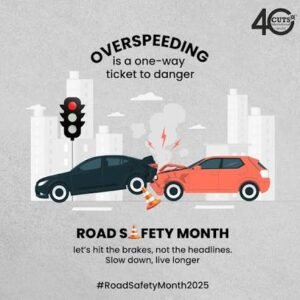
Let us do some simple maths. Suppose you are travelling 10 kilometres across the city. At an average of 40 km/h, the trip takes 15 minutes. At 60 km/h, it takes 10 minutes. You have saved five minutes, but you have taken on much greater risk, burned more fuel, increased wear on your vehicle and made your journey more stressful.
In city traffic, the real gain is often even smaller, because signals, junctions and congestion limit how far ahead you can actually get.
Practical Tips to Control Your Speed
- Start earlier. Most speeding comes from lateness. Leaving ten minutes sooner removes the pressure.
- Follow the limits. Posted speed limits are there for good reason. Watch for signboards, especially when the limit changes.
- Keep a safe following distance. Stay far enough behind the vehicle ahead to stop safely if they brake suddenly.
- Slow down in bad conditions. Rain, fog, dust and darkness all call for lower speeds.
- Use your mirrors and scan ahead. Smooth, anticipatory driving is faster and safer than sudden bursts of speed.
- Do not race or compete. Another driver’s impatience is not your problem to solve.
- Take breaks on long drives. Fatigue makes you drift into higher speeds without noticing.
A Word to Young Drivers
For many young people, speed feels exciting and is sometimes linked to showing off in front of friends. But the road is not a racetrack, and no stunt is worth a life. Real skill lies in control, patience and awareness, not in how fast you can go.
A Word to Parents
Children learn from what they see. If they watch you speed, overtake dangerously or lose your temper in traffic, they will copy it when they begin to drive. Be the driver you want them to become.
The Legal Reality
Overspeeding is a traffic offence, and penalties can include fines and, for repeated violations, action against your licence. But the real penalty is not on paper. It is the possibility of hurting someone, or yourself, in a way that cannot be undone.
Our Message from Next Wheel
A good driver is not the one who reaches first. A good driver is the one who reaches safely, every single time. At Next Wheel Driving School, we train learners to build speed judgment from the very first lesson, so that caution becomes second nature.
The next time you feel the urge to hurry, ask yourself one question: “Is saving a few minutes worth risking everything?” The answer is always no.
Learn to drive with confidence and control. Join Next Wheel Driving School today.
Leave a Reply